KLOW peptide composition and its listed shares
The largest share belongs to a copper-peptide complex. That starting point makes the ingredient inventory more useful than a single total weight.
The ingredient inventory
The usual research listing for KLOW peptide composition totals 80 mg. These weights describe contents of a preparation.
| Ingredient | Listed mass | Share of total mass |
|---|---|---|
| GHK-Cu | 50 mg | 62.5% |
| BPC-157 | 10 mg | 12.5% |
| TB-500 | 10 mg | 12.5% |
| KPV | 10 mg | 12.5% |
The 50:10:10:10 ratio is written in that ingredient order. All of the GHK-Cu complex counts towards its share: peptide and associated copper. The table does not describe the amount of copper metal in the mixture.
No official medicinal standard fixes what a KLOW preparation must contain. A listing and a blue appearance cannot verify the contents of an individual batch.
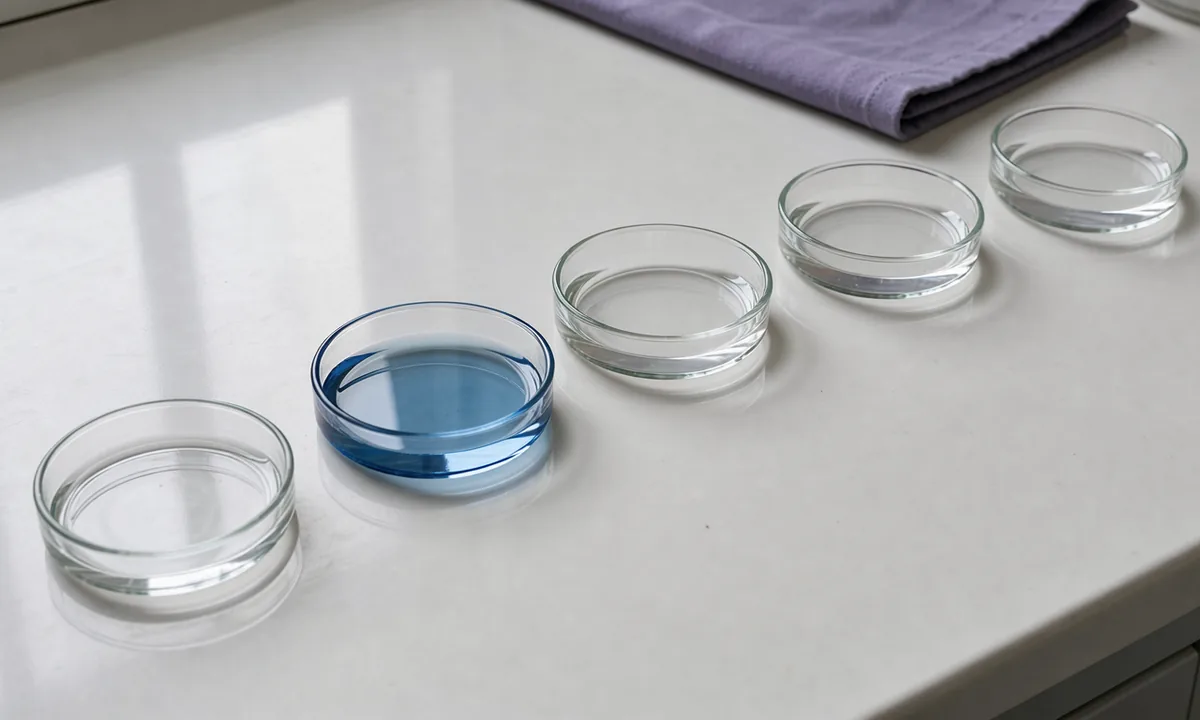
Why is KLOW peptide blue?
GHK-Cu is a complex of GHK and copper(II), also called Copper Tripeptide-1. Its copper accounts for the blue tint described in KLOW preparations. The GHK skin-regeneration review discusses the copper-binding peptide and its biological roles. The usual pairing is 1:1.
BPC-157, TB-500 and KPV carry no copper and add no blue tint. For a quick visual identification, blue has an obvious appeal. It is a very incomplete signal: the other ingredients still need identification, and colour establishes neither purity nor biological benefit.
Ingredient origins
GHK-Cu is the copper complex of the naturally occurring Gly-His-Lys tripeptide. KPV is the Lys-Pro-Val sequence from the end of alpha-MSH, a hormone involved in pigmentation and inflammatory responses. Its cell and mouse research concerns a particular short fragment with its own transport and anti-inflammatory behaviour.
BPC-157 is a synthetic 15-amino-acid peptide based on a sequence from a protein identified in human gastric juice. The rat Achilles-tendon experiment studied BPC-157 itself. TB-500 is a synthetic acetylated short fragment associated with the actin-binding region of thymosin beta-4. The familiar rat wound-closure experiment tested the full protein.
Putting those histories together explains the proposal behind the mixture. It does not supply an experiment showing cooperation among the ingredients.